
26 de November de 2025
How Modular Platforms Reduce Risks in Hospital Modernization Projects


Modernization in Healthcare: The Inevitable, Yet Risky, Imperative
Hospitals across the world are navigating a defining moment.
The demands of modern healthcare — digital patient records, interoperable systems, data-driven decision-making, and AI-enabled care — have made digital modernization not a choice, but a necessity.
Yet for many hospital executives, the question remains: How do we modernize without putting operations, budgets, or patient care at risk?
The truth is, healthcare modernization is unlike any other digital transformation. Hospitals operate within tightly regulated, high-stakes environments where even minor system disruptions can affect clinical continuity. When systems like patient management, billing, or clinical records are upgraded, the risks go far beyond IT downtime — they affect people’s lives.
Over the past decade, ECH Easy Healthcare has helped hospitals across Europe and Latin America navigate this very challenge: implementing new systems while keeping care safe, compliant, and uninterrupted.
The key lesson? Successful modernization doesn’t happen through massive, monolithic projects — it happens through modular, intelligent evolution.
The Risks of Traditional Hospital Modernization
Healthcare IT systems were traditionally designed as monolithic structures — massive, all-in-one platforms combining dozens of interdependent functions: patient management, billing, clinical documentation, laboratory systems, and more.
While these systems provided end-to-end coverage, they also came with inherent risks:
1. High Complexity and Interdependency
Any change in one component — such as adding a new workflow or updating a regulation — can cascade through the entire system.
Even minor upgrades often require months of planning, testing, and downtime coordination.
2. Long and Costly Implementation
Monolithic upgrades or replacements can take years to deliver and millions in investment before hospitals see value.
This often results in “big-bang” go-lives that are stressful for staff and risky for patient care continuity.
3. Resistance to Change
Large transformations demand that hospital teams adapt to new processes overnight. Without gradual change management, staff adoption suffers, resulting in low utilization and operational inefficiencies.
4. Limited Agility
Healthcare is constantly evolving — new clinical protocols, digital patient expectations, and emerging AI technologies require constant adaptation. Monolithic systems simply cannot keep pace without major re-engineering.
The result? Many modernization initiatives stall midway, exceed budgets, or deliver below expectations — creating “technology fatigue” across healthcare teams.

The Modular Alternative: Building Hospitals That Evolve Safely
A modular platform changes everything.
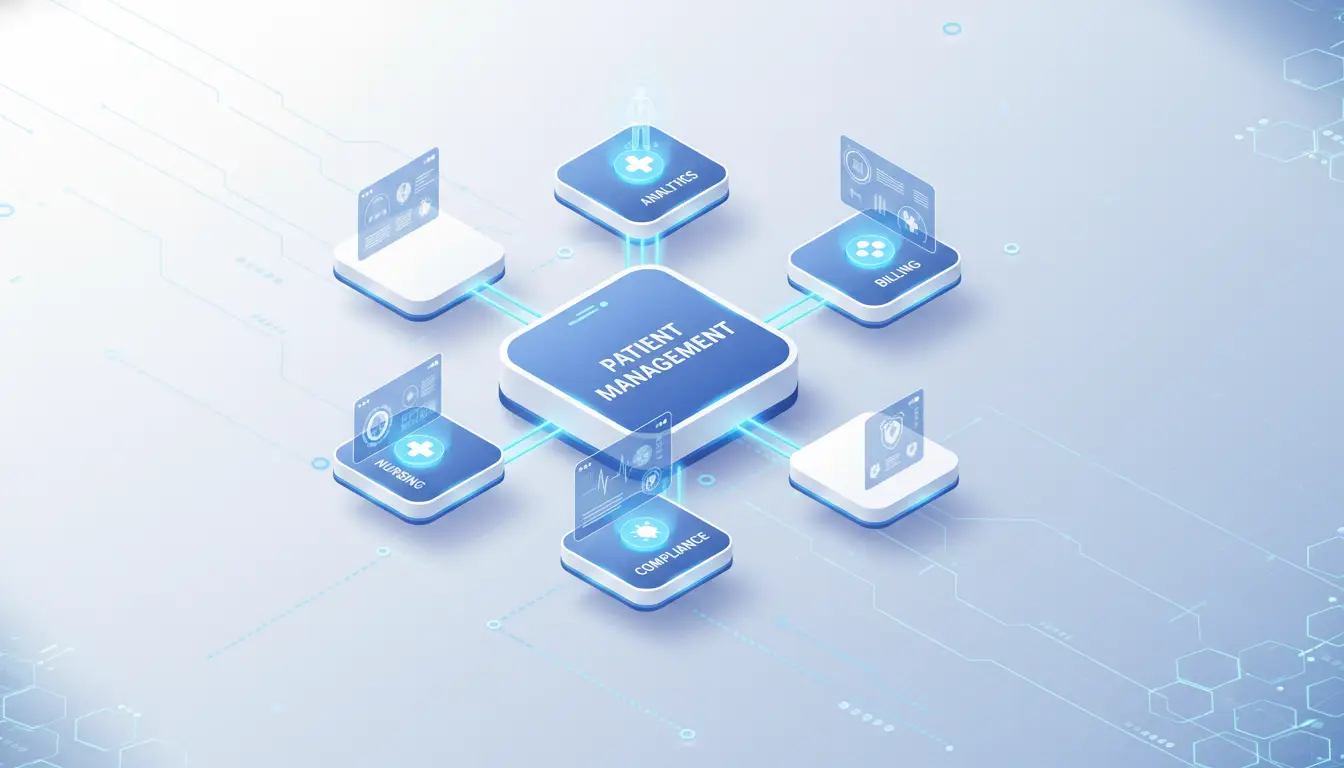
Instead of one massive, rigid system, hospitals adopt a network of interoperable modules — each dedicated to a specific domain (e.g., patient management, nursing assistance, billing, analytics, etc.).
Each module operates independently but connects through secure APIs and shared data standards. This means hospitals can innovate incrementally, upgrade selectively, and integrate progressively — reducing both financial and operational risks.
How Modular Platforms Reduce Risk
1. Progressive Implementation
Hospitals can start small — deploying one module (e.g., nursing management or billing) — prove value, and expand.
This phased approach minimizes disruption and allows staff to adapt gradually.
2. Business Continuity
Because each module operates independently, upgrades or replacements can occur without interrupting core clinical operations. Patient care continues seamlessly even during digital transformation.
3. Lower Financial Exposure
Modular rollouts allow hospitals to distribute investment over time. Rather than committing to a full-scale system overhaul, they can scale budgets in line with performance and results.
4. Easier Integration
Modules can connect with existing systems — whether legacy EHRs, imaging platforms, or laboratory systems — through API-based architectures. Hospitals gain innovation without starting from scratch.
5. Faster Value Realization
Each module delivers tangible value early, building confidence and stakeholder support for subsequent phases.
6. Future-Proof Flexibility
As technology evolves, hospitals can replace or enhance individual modules without reengineering the entire ecosystem — ensuring long-term sustainability.
How ECH and Globant Are Redefining Hospital Modernization
ECH: Deep Healthcare Process Expertise
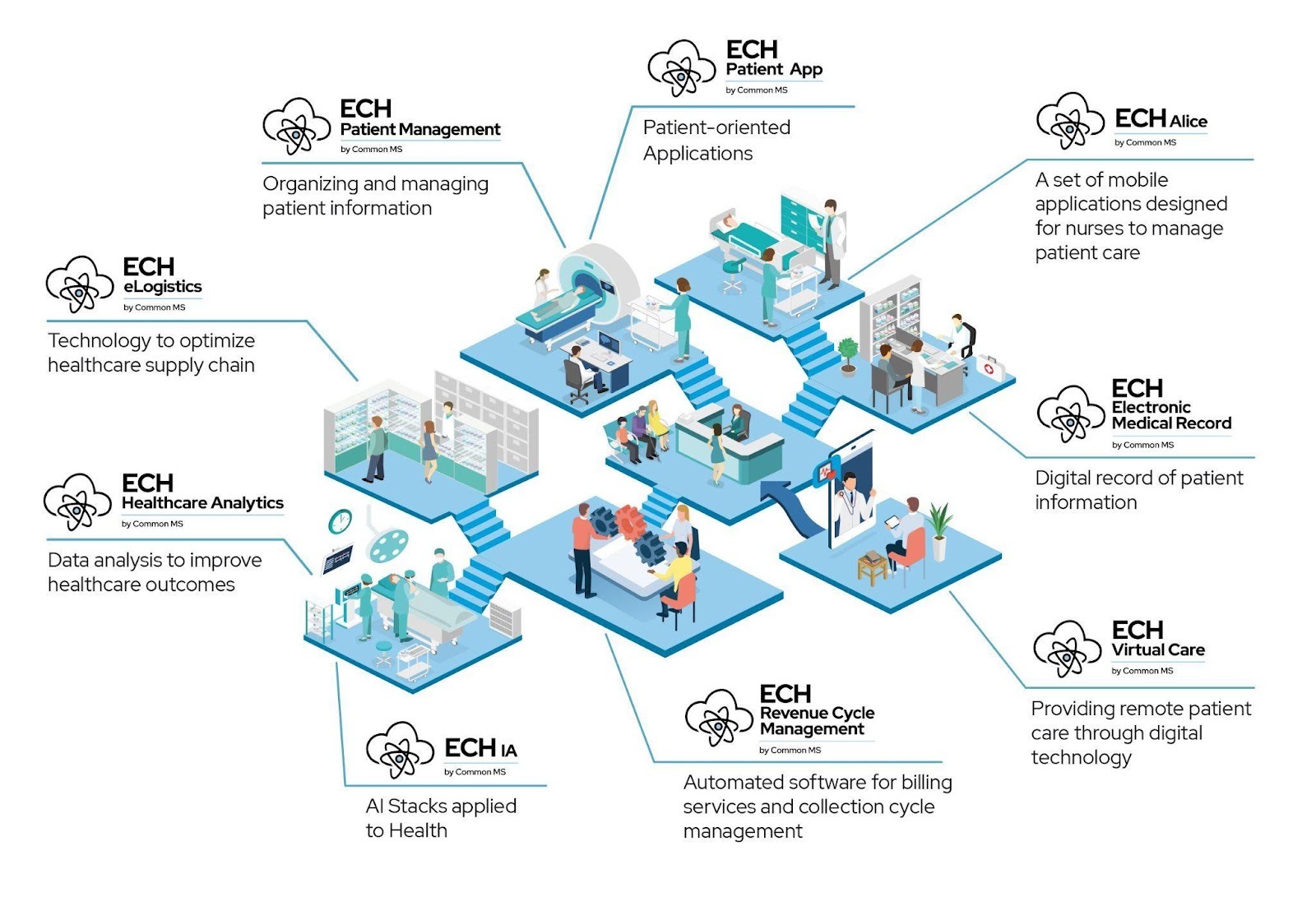
Easy Healthcare Consulting (ECH) specializes in designing and implementing intelligent healthcare ecosystems — bringing together years of experience in hospital operations, SAP healthcare solutions, and process transformation.
ECH helps hospitals modernize critical functions such as:
Globant Enterprise AI: The Smart Backbone of Modular Transformation
Partnering with Globant, a world leader in AI-powered digital platforms, ECH leverages Globant Enterprise AI as the foundation for modular transformation.
Enterprise AI acts as the connective tissue across hospital systems — integrating data, processes, and intelligence in real time. It’s not just a layer of automation; it’s an adaptive intelligence engine that makes every module smarter and every decision faster.
Key Capabilities of Globant Enterprise AI in Healthcare
- AI-Powered Integration
Enterprise AI connects new and legacy systems seamlessly. Hospitals can modernize one department at a time without breaking existing workflows or data consistency. - Predictive Analytics for Operations and Care
By analyzing patient flows, resource usage, and clinical trends, Enterprise AI helps hospitals anticipate bottlenecks, allocate resources, and predict demand surges. - Cognitive Process Automation
Routine administrative and clinical tasks — billing checks, appointment scheduling, discharge processing — can be automated, freeing up staff time for higher-value care. - Adaptive Governance and Compliance
The platform enforces data standards across all modules, ensuring compliance with GDPR, HIPAA, and national healthcare regulations. - Continuous Learning and Optimization
Enterprise AI learns from hospital workflows and outcomes, refining recommendations over time and improving accuracy with every cycle.
Modular by Design, Intelligent by Nature
When combined, ECH’s modular healthcare applications and Globant’s Enterprise AI architecture create a powerful ecosystem that allows hospitals to modernize incrementally, intelligently, and securely.
This collaboration gives healthcare organizations the ability to:
- Deploy core functions — such as patient management, clinical documentation, and nursing support — independently.
- Integrate data seamlessly across care, finance, and operations.
- Apply AI analytics to drive decision-making, reduce waste, and improve outcomes.
- Maintain business continuity while transforming systems progressively.
It’s modernization without disruption, innovation without risk, and transformation without uncertainty.
The Strategic Advantages for Hospital Leadership
For CIOs, CMOs, and hospital administrators, modular transformation offers several strategic benefits beyond IT:
- Operational Resilience Upgrades can occur with zero downtime, maintaining uninterrupted patient care.
- Financial Control Budget allocations can follow measurable performance outcomes, improving fiscal discipline and transparency.
- Staff Empowerment Gradual rollout and AI support tools (like Alice) help nurses and clinicians adopt new systems confidently.
- Data-Driven Decision-Making With Enterprise AI centralizing and interpreting data, executives gain real-time visibility into financial health, patient flow, and quality metrics.
- Regulatory Confidence Built-in compliance and audit trails across all modules reduce the burden of manual governance and reporting.
The Future: Adaptive, AI-Enabled Healthcare Ecosystems
The hospital of the future will not be defined by a single system, but by an ecosystem of connected, intelligent modules that evolve together.
In this new model:
- Data flows freely between clinical, financial, and operational areas.
- AI continuously monitors, predicts, and optimizes hospital performance.
- Upgrades happen without fear — because the system is designed to evolve.
With ECH’s modular process frameworks and Globant’s Enterprise AI, hospitals can finally achieve what every modernization project aims for: sustainable digital transformation with minimal risk and maximum value.
Conclusion: Modernization Made Safe
Hospital modernization no longer needs to be a leap of faith. With modular platforms and AI-driven architecture, it becomes a strategic, data-informed journey.
By combining ECH’s healthcare expertise with Globant’s Enterprise AI, hospitals gain the flexibility to modernize safely — one function, one department, one success story at a time.
Together, we’re building a future where technology adapts to healthcare — not the other way around.
A future where modernization is not a disruption, but a continuous improvement toward smarter, more humane care.